Manual bridge inspection is a structural liability.
Over 620,000 bridges. Most inspected by hand, documented on paper, with condition ratings that vary by inspector, not by bridge.
Weeks-Long Cycles
A standard bridge inspection — field work, documentation, and NBI report — takes 3–7 days plus weeks of report writing. Undetected defects propagate.
Inconsistent Ratings
The same bridge evaluated by two qualified inspectors produces different SNBI element condition ratings over 30% of the time. Subjectivity is a systemic problem.
Enormous Hidden Costs
FHWA spends $5.2B+ annually on bridge inspection. A significant portion goes toward manual documentation that doesn't improve maintenance outcomes.
From raw image to SNBI-linked report.
Under 10 minutes.
Upload Field Images or Revit BIM
Drag-and-drop photos from inspection cameras or smartphones. Or upload your bridge's Revit model. StruxAI accepts JPEG, TIFF, RAW, IFC, RVT, and NWD. Batch processing up to 10,000 images.
AI Detects, Classifies & Links to SNBI
StruxVision™ — trained on 2.4M+ FHWA-annotated images — detects cracks at 0.1mm resolution, corrosion, spalling, and joint failure. Every finding is automatically linked to its SNBI element with correct condition states. 340ms inference.
SNBI Report Auto-Generated
A complete SNBI/NBI-compliant report is generated: element inventory, condition ratings with quantities, GPS-mapped findings, risk score, maintenance recommendations, and predictive deterioration forecast. Push to AASHTOWare.
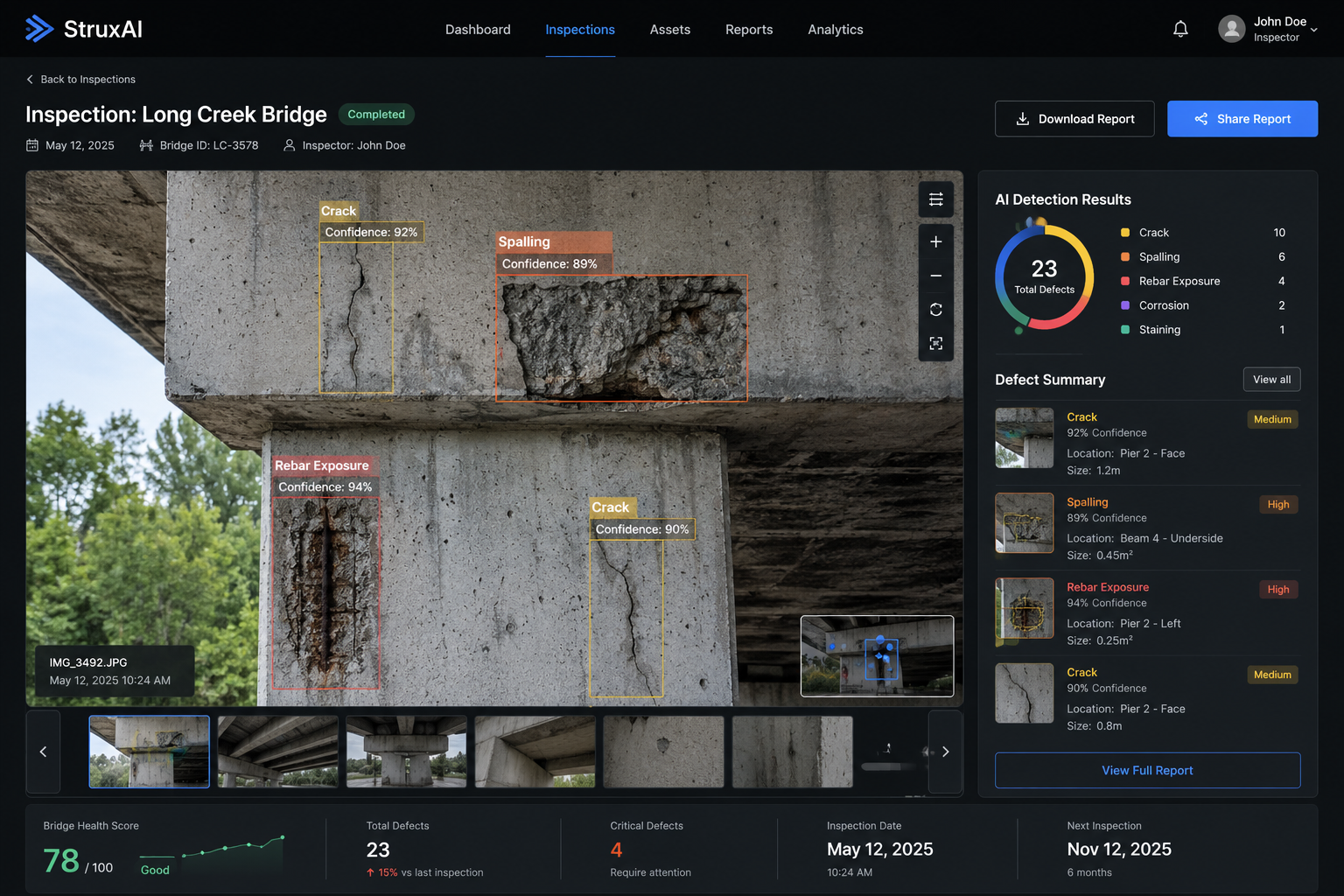
Defects found. SNBI-classified. Report-ready.
StruxVision™ detects and geo-locates every defect, maps it to its SNBI element, assigns condition states, and outputs it directly into your NBI inspection report.
Real numbers from real deployments.
Every role in the inspection chain.
Book a 30-minute live demo.
See SNBI element auto-linking, BIM integration, predictive maintenance forecasts, and full report generation — live, with your own images if you'd like.
No spam. SOC 2 Type II controls. Your data is never sold.